
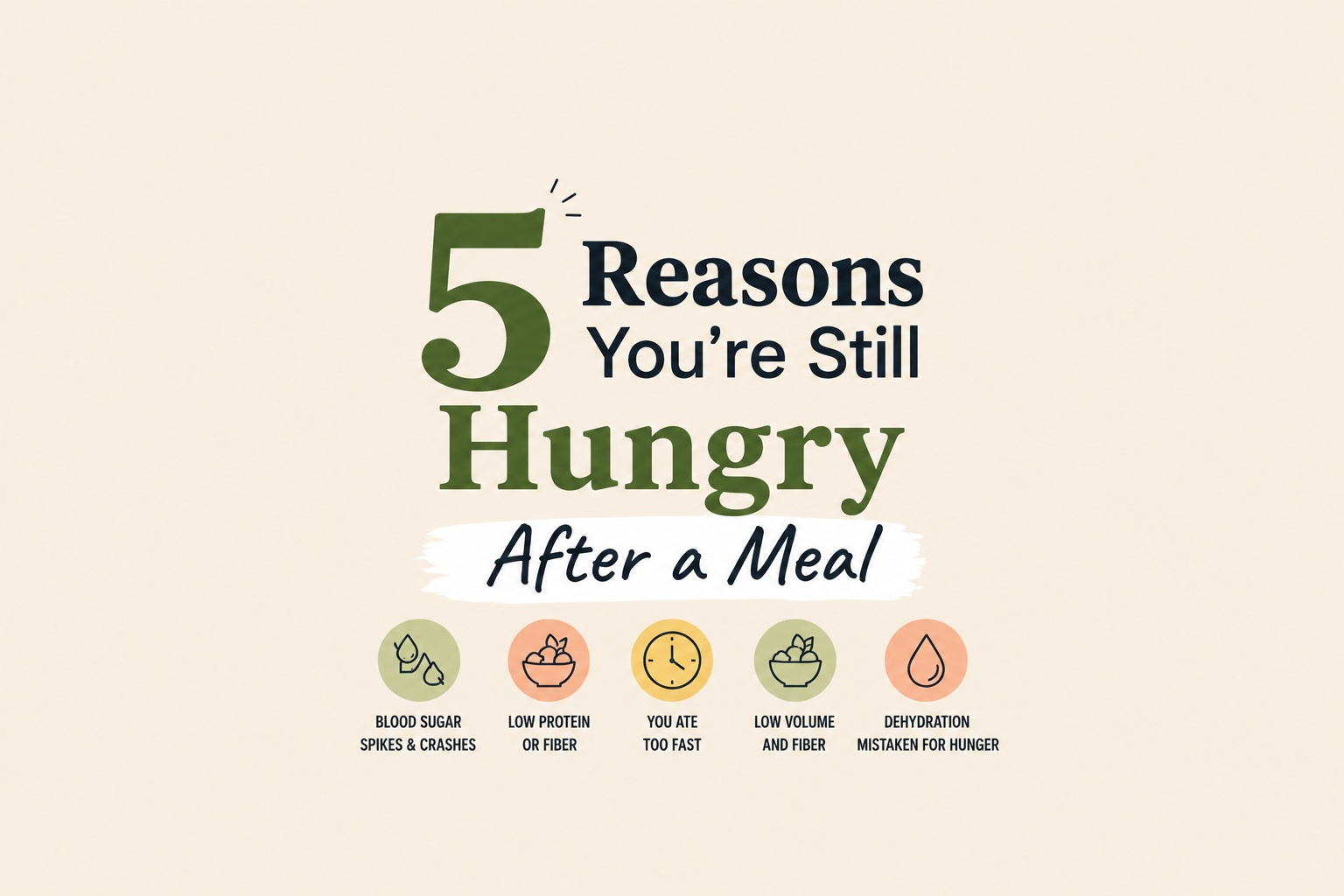
You just ate a full meal — and you’re already hungry again. If you’re asking yourself why am I still hungry after eating a meal, you’re not alone and you’re definitely not broken. Your meal just wasn’t built in a way that works with your hunger, and that’s actually a fixable thing. Here are the five most common reasons it keeps happening and what to do about it.
Here are the five most common reasons it’s happening, and what to actually do about it.
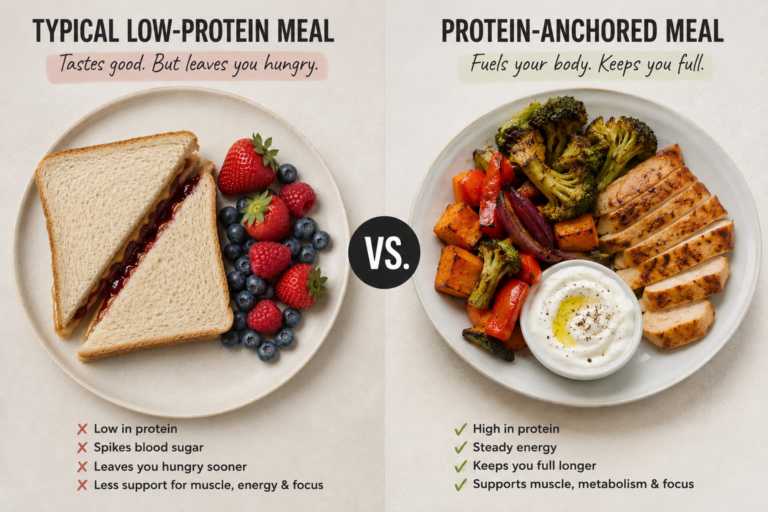
1. You Didn’t Eat Enough Protein
Protein is your satiety MVP. It triggers the hormones that tell your brain okay, we’re good — and suppresses the hormone that makes you feel hungry in the first place. Studies back this up consistently: higher-protein meals keep you fuller longer and reduce how much you eat later in the day.
Most people think they’re eating enough protein. Most people are not.
Aim for 25–40 grams per meal. That’s roughly a palm-sized portion of chicken, fish, or beef — or a cup and a half of Greek yogurt or cottage cheese. If your meal was mostly carbs (even good ones), that’s probably why you’re still hungry an hour later.
A lot of my clients eat meals that look healthy — salads, smoothies, yogurt parfaits — but when we map out the actual protein, it’s 10–15 grams. That’s not enough to hold you. Every meal needs a protein anchor, full stop.
2. You Ate Too Fast
There’s a real lag between eating and your brain registering that you’re full — about 15–20 minutes. If you finished your meal in seven, your body never got the memo.
Research shows eating slowly increases satiety hormones and helps people eat less without even trying. You don’t have to turn dinner into a meditation retreat. Just put your fork down between bites, drink some water, and sit down if you can — even for ten minutes.
This one hits different for people with irregular schedules. You go hours without eating, finally get a break, and inhale whatever’s in front of you. By the time your hunger cues catch up, you’ve already eaten past the point — or you’re still somehow hungry. Slowing down actually helps both scenarios.
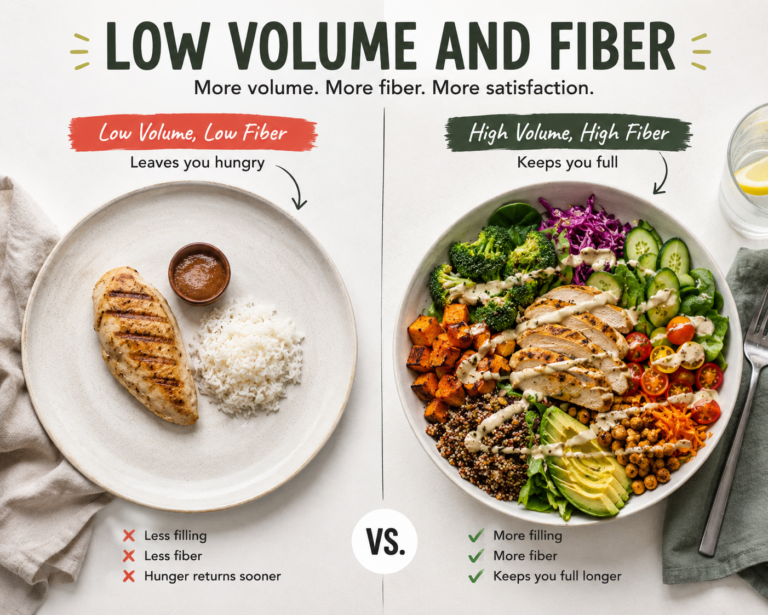
3. Your Meal Was Low in Volume and Fiber
Food volume matters. High-fiber, high-volume foods — think a big pile of roasted vegetables, a broth-based soup, a salad with actual stuff in it — physically take up space in your stomach and send signals that you’ve had enough. Research confirms fiber slows digestion, keeps you full longer, and supports the gut hormones that regulate hunger.
A 500-calorie bag of chips hits very differently than a 500-calorie meal built around vegetables and protein. Not because of the number — because of what that food does inside your body.
Aim to make at least half your plate non-starchy vegetables at most meals. It doesn’t have to be fancy. A bag of frozen broccoli counts.
4. You’re Actually Just Thirsty
I know, I know — you’ve heard this one. But there’s real science behind it: mild dehydration can genuinely be mistaken for hunger because the signals overlap in the brain. One study found that drinking water before meals meaningfully reduced calorie intake. Another showed many people reach for food when they actually need fluids.
Before you go hunting for something else after a meal, drink 8–12 oz of water and wait ten minutes. If the “hunger” dissolves, you have your answer.
This one comes up constantly with clients in late-night industries — bartenders, DJs, event staff — who spend hours in loud, dry venues. They get home at 2am convinced they’re starving, and a lot of the time it’s dehydration plus low blood sugar. A big glass of water and a small snack usually does it.
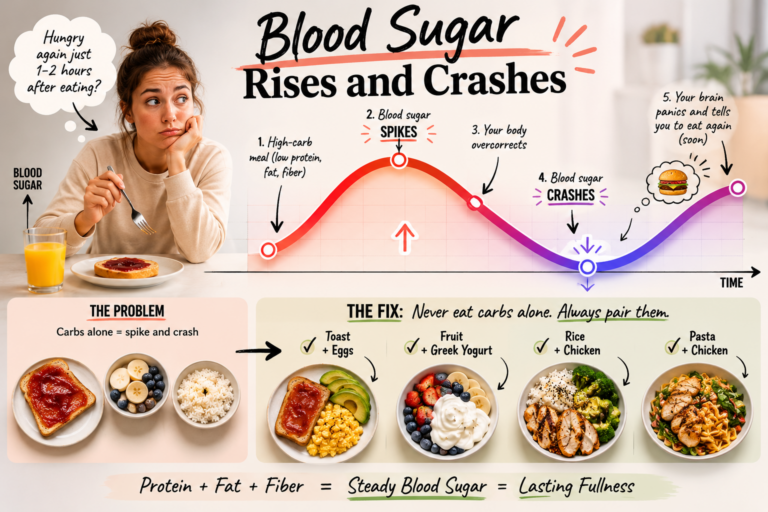
5. Your Blood Sugar Crashed
If you’re hungry again within an hour or two of eating, this is probably what’s happening. A high-carb meal without enough protein, fat, or fiber causes a blood sugar spike — your body overcorrects, your blood sugar drops, and your brain panics and tells you to eat again. Even if you just did.
You don’t need a diabetes diagnosis for this to happen. It’s common, especially with meals that are carb-heavy and protein-light.
The fix is simple: never eat carbs alone. Always pair them with protein and fat. Toast needs eggs. Fruit needs Greek yogurt. Rice needs chicken. That combination slows everything down and prevents the crash that sends you back to the kitchen.
The Short Version
Hunger after a meal isn’t a willpower problem. It’s a meal structure problem — and it’s solvable.
Build your meals around protein + fiber + fat + some water, eat slowly enough for your body to catch up, and the constant hunger usually resolves faster than you’d expect. Give it a week of being intentional about it and see what shifts.
You’ve got this.
References
- Leidy HJ, et al. The role of protein in weight loss and maintenance. American Journal of Clinical Nutrition. 2015. DOI: 10.3945/ajcn.114.084038. PMID: 25926512.
- Kokkinos A, et al. Eating slowly increases the postprandial response of anorexigenic gut hormones. Journal of Clinical Endocrinology & Metabolism. 2010. DOI: 10.1210/jc.2009-1018. PMID: 19875483.
- Slavin JL. Dietary fiber and body weight. Nutrition. 2005. DOI: 10.1016/j.nut.2004.08.018. PMID: 15795346.
- Dennis EA, et al. Water consumption increases weight loss during a hypocaloric diet intervention. Obesity. 2010. DOI: 10.1038/oby.2009.235. PMID: 19661958.
- Paddon-Jones D, et al. Protein, weight management, and satiety. American Journal of Clinical Nutrition. 2008. DOI: 10.1093/ajcn/87.5.1558S. PMID: 18469287.
Frequently Asked Questions
Why am I hungry an hour after eating a full meal?
Usually it comes down to meal structure — not enough protein, a blood sugar spike and crash from a carb-heavy meal, or eating too fast for your satiety hormones to kick in. The fix isn’t eating less, it’s eating smarter. Rebuild your meals around a solid protein anchor (25–40g), add fiber and fat, and give yourself time to actually eat.
How much protein do I need to feel full?
Aim for 25–40 grams per meal — roughly 4–6 oz of chicken, fish, or beef, or 1–1.5 cups of Greek yogurt or cottage cheese. Less than 20 grams per meal, and most people won’t stay full for very long, no matter what else is on the plate.
Does drinking water actually help with hunger?
Yes, genuinely. Mild dehydration can be misread as hunger, and drinking water before or during meals helps you tune into real satiety signals. If you finish a meal and still feel snacky, try a big glass of water and wait ten minutes before reaching for more food.
What foods will keep me full the longest?
High-protein, high-fiber foods are your best bet — eggs, chicken, fish, Greek yogurt, cottage cheese, lentils, beans, vegetables, and fruit like apples and berries. The combination of protein + fiber + fat at each meal creates the most sustained fullness because all three slow digestion and stabilize blood sugar.
Why am I always hungry at night even after dinner?
Late-night hunger usually means dinner was low in protein or fat, or your blood sugar is crashing from an unbalanced day of eating. Look at what dinner actually contains — especially protein — and whether the rest of your day is setting you up for a blood sugar dip by 9pm. A balanced dinner with 30+ grams of protein makes a noticeable difference for most people.
Can stress or bad sleep make me hungrier?
Yes, and the research is clear on this. Poor sleep increases ghrelin (your hunger hormone) and decreases leptin (your fullness hormone) — so you’re physiologically hungrier and less satisfied after eating. Chronic stress raises cortisol, which ramps up appetite, especially for high-sugar, high-fat foods. No meal plan fully compensates for chronic sleep deprivation. It’s worth paying attention to.
How do I stop feeling hungry without restricting more?
Eat more protein. Seriously — that’s usually the answer. Most people who feel constantly hungry are under-eating protein and over-relying on carbs, not eating too many calories overall. Fix the balance of your meals before cutting anything out. Restriction usually makes the hunger worse.