
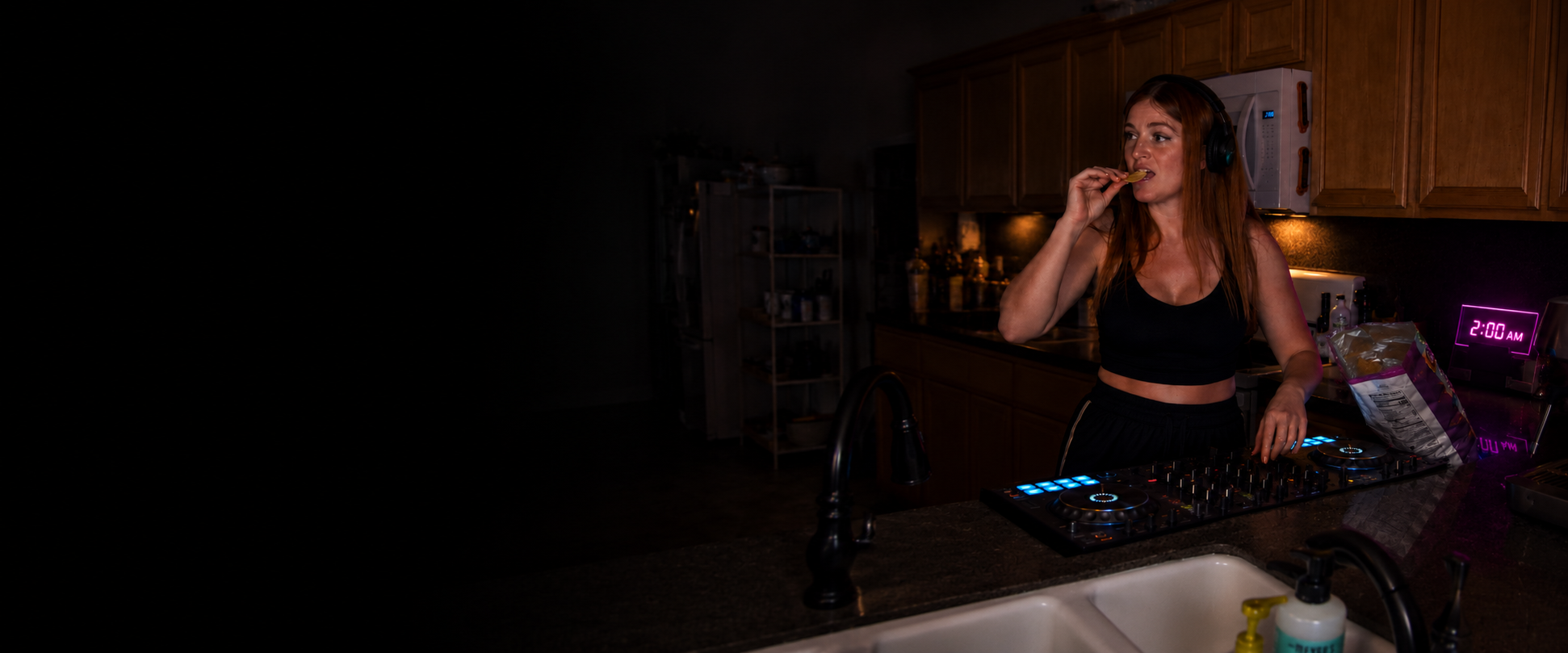
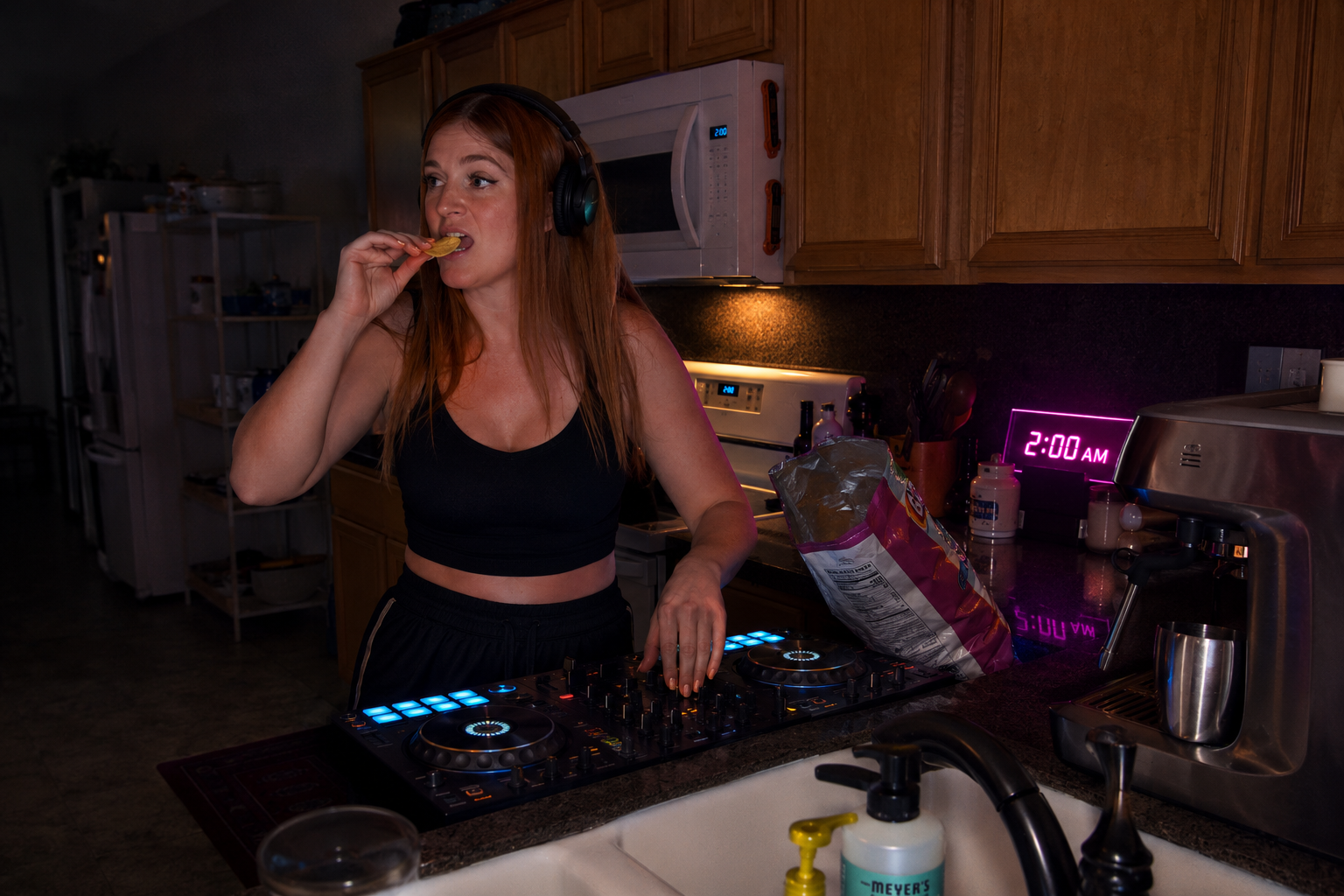
If you’ve ever come home from a gig and eaten half a bag of tortilla chips standing over the sink — and wondered why you can’t stop eating at 2am — this one’s for you.
Late-night eating after a gig isn’t a willpower problem. For DJs, musicians, and night shift workers, it’s a biology problem. And once you understand why it keeps happening, you can stop fighting yourself and start actually working with your body instead of against it.
I’ve been there. Long set, great energy in the room, loading out after midnight, driving home wired. And the second I walk through the door — I’m ravenous. That’s if I didn’t already hit In-N-Out on the way home. Sound familiar?
The reason you can’t stop eating late at night has everything to do with your cortisol, your circadian rhythm, and your hunger hormones — all of which go completely haywire on a late gig schedule. Let’s break it down.
Your Body Has No Idea You’re Just a DJ
Here’s the thing: your body doesn’t know you were spinning tracks. It just knows you were in a loud, high-stimulation environment for hours, on your feet, burning mental and physical energy. And it responds the same way it would to any major stressor.
Enter cortisol.
1. Cortisol: The Hype Man That Can’t Stop Eating
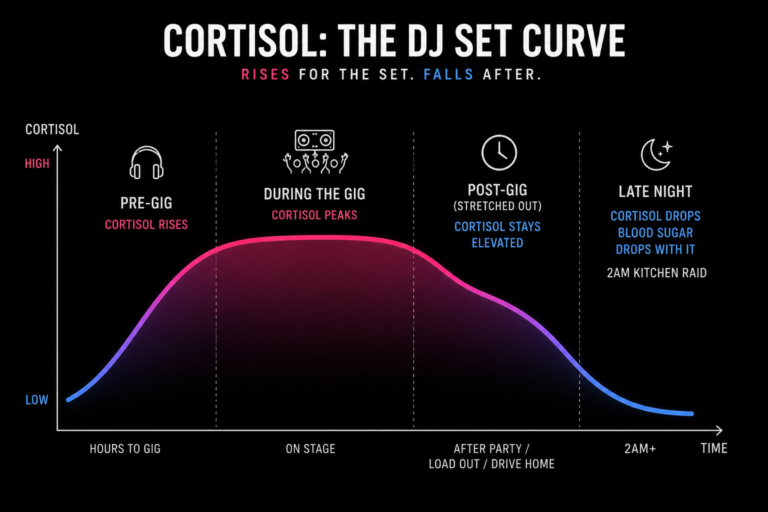
Your cortisol spikes before and during a gig — and honestly, that’s your body doing it’s job. Cortisol is considered the ‘stress hormone’, but it also is the hormone that makes you feel sharp, switched on, and ready. Cortisol rises during those pre gig nerves, the crowd energy, even the volume of the room. That’s why you can play for five hours straight and feel like you’re crushing it the whole way through.
But here’s what happens after: cortisol is supposed to drop when the stressor ends. Except for us, the “end” is stretched out. You’re still talking to guests, loading equipment, maybe grabbing food with the couple, driving home. The comedown is delayed. And when cortisol finally does drop? Blood sugar drops with it. Fast. That’s the 2am kitchen raid.
Here’s the thing about cortisol — it runs on a schedule. It typically peaks in the morning to wake you up and get moving, then gradually drops throughout the day, hitting its lowest point at night.. So by the time you’re finishing a gig at midnight, your body’s cortisol is already close to zero. Then it crashes the rest of the way. Research shows that regularly eating and working late wears on your metabolism, immune function, and blood sugar control over time. In other words: one late gig won’t wreck you. But if this is your schedule every weekend, your body never fully resets.
So when you crash, you crash hard — and whatever is easiest to eat wins. Not because you’re weak. Because your decision-making is depleted right alongside your blood sugar.
What this means for you: Having a small, planned snack ready before the crash hits is way more effective than trying to make a good food decision at midnight with zero fuel and maximum exhaustion… and cravings. Keep a snack with you that has protein like a protein bar, jerky sticks, apple sauce packs, roasted edamame, or trail mix.
2. Your Body Clock Clocked Out at 10pm, and Now You Can’t Stop Eating at 2am
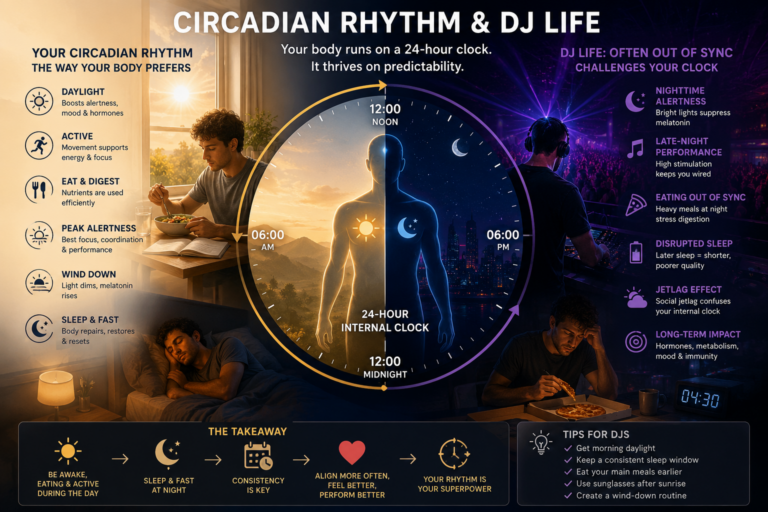
Let’s talk about your circadian rhythm — your body’s internal 24-hour clock. It regulates sleep, digestion, hormones, metabolism, basically everything. And it strongly prefers predictability: be awake, eating, and active during the day — sleep and fast at night.
But as a working DJ, your schedule can look a lot different. Performing during hours your body is trying to wind down, eating a real meal at 11pm, sleeping at 3am — or 6am — waking up in the afternoon. Right? When gig nights flip that script, it throws off your hormones, makes your body less efficient at processing carbs, and over time can affect your metabolism if you’re not paying attention.
To be clear though: eating at night doesn’t automatically make you gain weight. Total food intake still matters most. But your digestion is slower late at night, your blood sugar response is less efficient, and a heavy meal at midnight is just going to feel worse than that same meal at noon.
What this means for you: On gig nights, eat a balanced meal — protein, carbs, and some produce — before you perform. That way you’re not running on empty at midnight making frantic decisions. Whatever you eat after the gig can be lighter, but still satisfying.
3. Ghrelin & Leptin: Your Hunger Signals Are Flying Blind Causing You Nonstop Eat at 2am
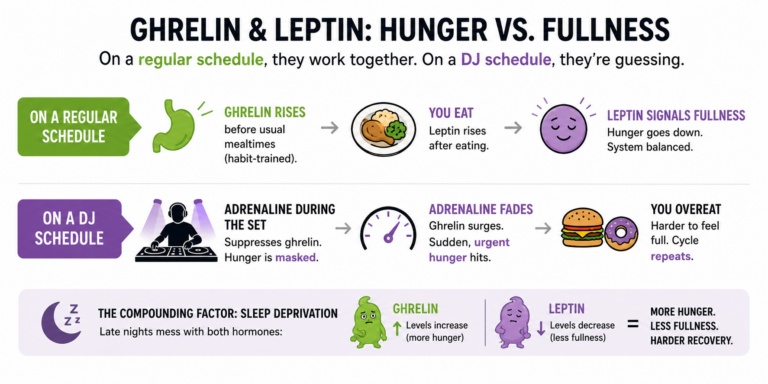
Okay, two more players: ghrelin (hunger hormone) and leptin (fullness hormone). On a regular schedule, these work together like a decent feedback system. On a DJ schedule? They’re basically guessing.
Normally ghrelin spikes before your usual mealtimes — it’s habit-trained. But adrenaline suppresses it during a set, which masks hunger. The second that adrenaline fades? Ghrelin surges. That’s the sudden, urgent hunger hits you.
And here’s where it compounds: the sleep deprivation that comes with late nights messes with both of these hormones. Research from the University of Chicago found that even partial sleep restriction was associated with an 18% decrease in leptin and a 28% increase in ghrelin — along with a 24% increase in hunger and appetite.
Sleep deprivation resulted in lower concentrations of the satiety hormone leptin and higher levels of the hunger-promoting hormone ghrelin — meaning the day after a late gig, you are genuinely, biologically hungrier than normal. Not tired and bored-snacking. Actually hungrier. Your hormones are driving that.
So: high ghrelin + low leptin + cortisol crash + decision fatigue + limited food options at 2am = the perfect recipe for overeating foods that don’t make you feel great. None of that is a character flaw. It’s just biology doing exactly what it’s supposed to do.
What this means for you: The morning after a late gig, prioritize protein at breakfast — eggs, Greek yogurt, breakfast meats, cottage cheese, protein pancakes, a protein smoothie or shake, whatever. Protein is the most satiating macronutrient we have, and it’ll help stabilize those hunger signals before they spiral. Don’t skip breakfast thinking you’ll “make up for” the night before. That usually just makes things worse later in the day.
The Bigger Picture (Without the Lecture)
I’m not telling you to quit gigging at night. That would be insane. I’m not even saying late-night eating is inherently terrible — because it’s not, especially when you understand what’s driving it and have a plan.
What I am saying is: you’re not broken. You’re not undisciplined. You’re operating on a schedule that works against your body’s default settings, and your body is responding exactly the way it’s wired to.
Once you understand that, you can actually build a system around it. Small things — a pre-gig meal, a post-gig snack that’s already waiting for you, a decent breakfast the next morning — compound into real, sustainable changes. No perfection required.
That’s the remix.
Karen’s Coaching Take
The most common thing I see with DJ and musician clients isn’t bad intentions — it’s no plan for the transition window. The 30-60 minutes after a gig ends is where things go sideways, because there’s nothing waiting for them at home and they’re crashing hard.
The fix isn’t complicated: just have something decided in advance. Doesn’t have to be fancy. A Fairlife protein shake in the fridge, a peanut butter sandwich on whole grain, a bowl of cereal — something with protein and carbs that doesn’t require cooking or thinking. So when you’re operating on fumes at 1am, the decision is already made.
The clients who do this consistently? They stop feeling out of control on gig nights. Not because they’re suddenly disciplined. Because they removed the need for discipline at the exact moment it’s in shortest supply.
Frequently Asked Questions
Why am I so hungry after a gig even though I wasn’t hungry during it?
This is the cortisol-adrenaline rebound. While you’re performing, your stress hormones suppress your appetite — that’s why you can DJ for hours and barely think about food. But when those hormones drop at the end of the night, hunger hits hard and fast. It’s not emotional eating. It’s just your body crashing after hours of running on cortisol and adrenaline. The best move is eating a solid meal before your gig so you’re not starting from empty when that crash hits.
Does eating late at night actually cause weight gain?
Not automatically, no. Total calorie intake over time is still the primary driver of weight changes. What’s true is that late-night eating is associated with higher blood sugar levels and poor digestion. The bigger issue is usually that late-night eating tends to be reactive and unplanned — chips, fast food, whatever’s around — rather than the timing itself. A planned, balanced post-gig meal is a different situation than a chaotic 2am binge.
What should I eat before a gig?
Aim for a balanced meal 1-2 hours before you perform: protein + complex carbs + fat + some vegetables if you can swing it. Think grilled chicken with rice and broccoli (if you want to keep it simple), a turkey sandwich on whole grain, or even something like Greek yogurt with fruit and a handful of nuts. You want sustained energy — not a blood sugar spike that crashes mid-set, and not so heavy that you feel sluggish on your feet. Avoid anything too sugary, greasy or unfamiliar right before a big event.
What’s the best late-night meal or snack after a gig?
It depends how hungry you are. If you need a full meal, a healthy fast food order or a microwave meal you prepped ahead works perfectly — no shame in either. If a snack is enough, go for something with protein and carbs: Fairlife chocolate milk, Greek yogurt with granola, cottage cheese with fruit, a protein bar, or honestly even a bowl of cereal with milk. The goal isn’t perfection — it’s having something reasonable already decided before you get home so you’re not standing in front of the fridge at 2am making chaotic decisions.
Why am I so hungry the day after a late gig?
Sleep deprivation directly impacts the hormones that regulate hunger. Research shows that even partial sleep restriction is associated with a meaningful decrease in leptin (the fullness hormone) and an increase in ghrelin (the hunger hormone). The result is that you’re genuinely hungrier than normal the next day — not imagining it, not being dramatic. Prioritizing protein at breakfast helps stabilize these signals. And if you can get a full night of sleep the following night, your hunger hormones should regulate back toward normal.
Does my circadian rhythm actually affect my metabolism?
Yes, in real and meaningful ways. Your body’s internal clock regulates insulin sensitivity, digestion speed, and how efficiently you process nutrients — and these shift throughout the day. Insulin sensitivity is generally higher in the morning and lower at night, meaning the same meal can produce a different blood sugar response depending on when you eat it. For DJs on irregular schedules, this doesn’t mean nighttime eating is off-limits — it means understanding that your body isn’t operating at peak metabolic efficiency during late-night hours, and planning accordingly.
Should I try to eat on a regular schedule even with gig nights?
Yes, as much as possible — but “regular” doesn’t have to mean 8am-6pm. It means finding your own consistent rhythm that accounts for your actual schedule. If you gig Friday and Saturday nights, plan your eating around that. Eat a solid meal before you perform. Keep a planned post-gig snack ready. Eat a good breakfast the next morning regardless of when you wake up. The more consistent your eating anchors are, the better your hunger hormones can calibrate — even if your schedule is later than average.
Is this just a problem for DJs or does it apply to other night-shift workers too?
The hormonal and circadian effects are well-documented in night shift workers broadly — nurses, bartenders, truck drivers, anyone who works during hours their body expects to be resting. DJs have a specific version of this because gig nights are typically irregular (not every night), which can actually be harder on the body than a consistent night schedule. Your body never fully adjusts because the schedule keeps changing. That’s all the more reason to build anchor habits around your gig nights rather than trying to flip your entire lifestyle.
Can I lose weight even with a late-night schedule?
Yes. It’s harder to navigate than a traditional schedule, but it’s absolutely workable. The key is total food intake over time, food quality, and having systems in place for your highest-risk moments (the post-gig window, the day after). People with irregular schedules often do well with flexible approaches — not rigid meal plans, but anchor habits like a pre-gig meal, a post-gig snack limit, and a solid breakfast. Working with a dietitian who actually understands your schedule (and doesn’t just tell you to eat dinner at 6pm) makes a real difference.
References
- Braz GRF, et al. Chrononutrition and Energy Balance: How Meal Timing and Circadian Rhythms Shape Weight Regulation and Metabolic Health. Nutrients / PMC. 2025. https://pmc.ncbi.nlm.nih.gov/articles/PMC12252119/
- Chung N, et al. Timing Matters: The Interplay between Early Mealtime, Circadian Rhythms, Gene Expression, Circadian Hormones, and Metabolism — A Narrative Review. Nutrients. 2023. PMID: 37764740. https://pmc.ncbi.nlm.nih.gov/articles/PMC10528427/
- Salavert C, et al. “Feeding the Rhythm” — Effects of Food and Nutrients on Daily Cortisol Secretion: From Molecular Mechanisms to Clinical Impact. International Journal of Molecular Sciences. 2025. https://www.mdpi.com/1422-0067/26/22/11230
- Wang M, et al. Feeding the Night Shift: Timing, Cortisol, and What to Do Next (Editorial). PMC. 2025. https://pmc.ncbi.nlm.nih.gov/articles/PMC13017200/
- Centofanti S, et al. Exploring Circadian and Meal Timing Impacts on Cortisol During Simulated Night Shifts. SLEEP. 2026. PMID: 40838738. https://pubmed.ncbi.nlm.nih.gov/40838738/
- Brown RB. Late-Night Feeding, Sleep Disturbance, and Nocturnal Congestion Mediated by Hyperglycemia, Renal Sodium Retention, and Cortisol: A Narrative Review. Clocks & Sleep. 2025. DOI: 10.3390/clockssleep8010001. https://pmc.ncbi.nlm.nih.gov/articles/PMC12821527/
- Spiegel K, Tasali E, Penev P, Van Cauter E. Sleep Curtailment in Healthy Young Men Is Associated with Decreased Leptin Levels, Elevated Ghrelin Levels, and Increased Hunger and Appetite. Annals of Internal Medicine. 2004. DOI: 10.7326/0003-4819-141-11-200412070-00008. PMID: 15583226. https://pubmed.ncbi.nlm.nih.gov/15583226/
- van Egmond LT, et al. Effects of Acute Sleep Loss on Leptin, Ghrelin, and Adiponectin in Adults with Healthy Weight and Obesity. Obesity. 2023. DOI: 10.1002/oby.23616. PMID: 36448248. https://pubmed.ncbi.nlm.nih.gov/36448248/
- Taheri S, et al. Short Sleep Duration Is Associated with Reduced Leptin, Elevated Ghrelin, and Increased Body Mass Index. PLOS Medicine. 2004. DOI: 10.1371/journal.pmed.0010062. PMID: 15602591. https://pubmed.ncbi.nlm.nih.gov/15602591/